

 LinkedIn
The software is the easy part of selling AEO across 10+ client domains. The per-domain math and the dev hours nobody budgets for are where retainers die.
What software do marketing agencies use to manage AI visibility for clients?
Most agency AI visibility software falls into two buckets, and your retainer depends on which one you buy. Monitors track prompts and tell you where a client is not mentioned. Execution platforms do the work: publish pages, fix technical issues, and build citations.
I used to tell clients a tracking dashboard was enough. I was wrong. A monitor can surface a prompt gap, but someone still has to decide what to publish and ship it. That is why buyers complain about AEO sellers handing over checklists they could do themselves. If you resell a monitor, you may still owe 10+ hours of fulfillment per client. If you resell execution through groas for agencies, fulfillment is the product and your team stays client-facing.
Buy the work you intend to sell. A dashboard is not delivery.
Should I white-label AI SEO or build it in-house?
It depends on how many domains you need to fulfill next month, not how ambitious your roadmap sounds. Say you have three SEO generalists and someone asks for AEO across 12 domains by next quarter. Building in-house means hiring or retraining for answer-engine content, technical fixes, citation building, and weekly AI-visibility tracking. You carry that payroll whether clients stay or churn. White-labeling lets you keep the client relationship and markup while someone else executes under your brand.
This tripped me up early. I thought keeping fulfillment in-house protected quality. What it protected was payroll bloat.

There is a case for building. If you already have a technical content team with spare capacity, direct CMS access to every client site, and a partner who will own AI search full-time, use them. Otherwise, buy execution and sell strategy. Clients pay for outcomes and a report they can forward to their boss, not for watching you learn prompt tracking on their retainer.
If you cannot name the person who will do the work for domain number 11, you do not have an in-house product yet.
Why does per-prompt pricing wreck agency margins?
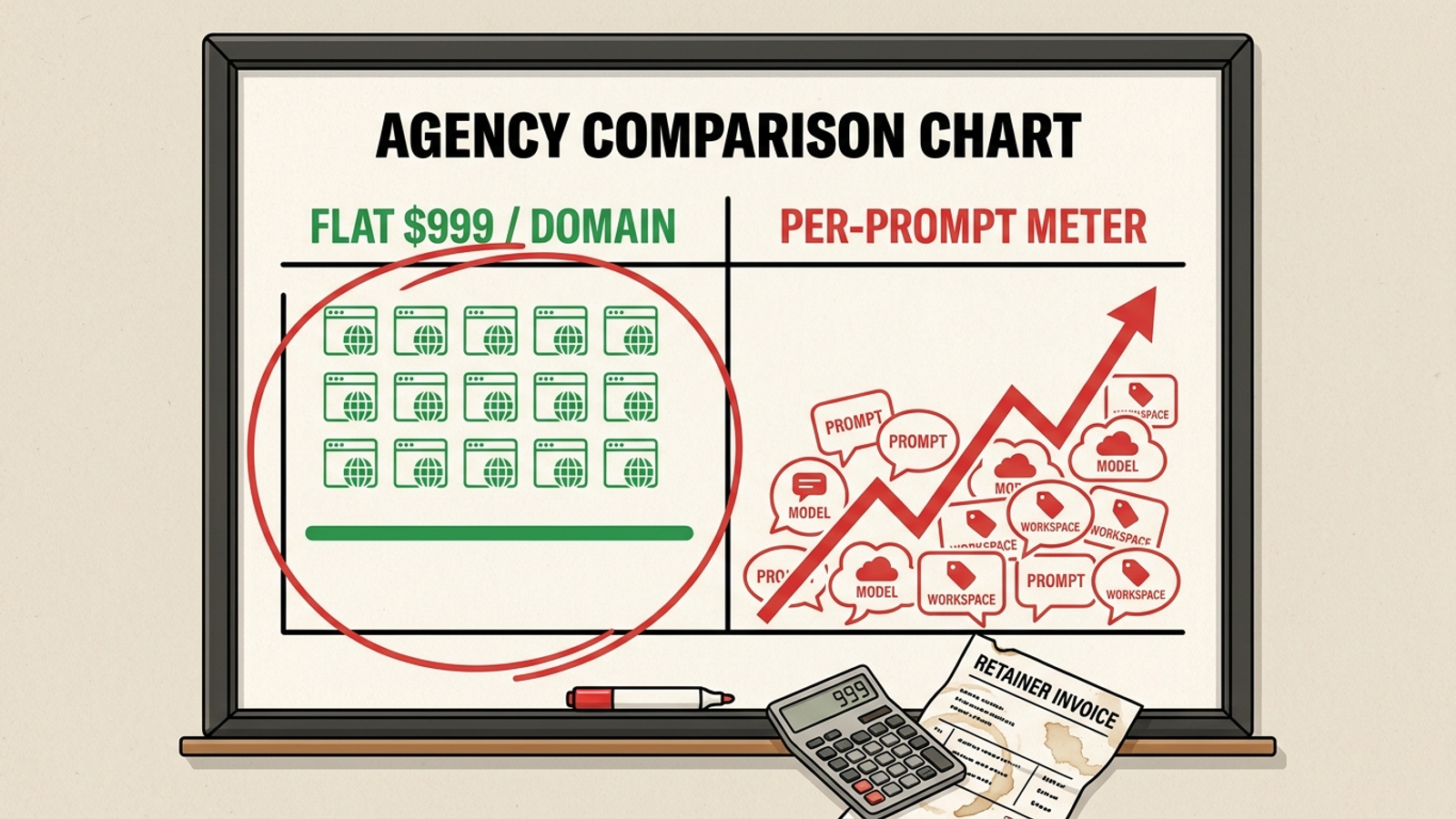
Because you resell certainty and buy variability. You sell a client a flat $1,500 retainer. Then your platform bills by prompts tracked, models checked, and workspaces added. One client wants 40 buyer prompts across ChatGPT, Perplexity, Gemini, and Claude, daily. Another wants the same coverage plus Copilot. Your bill changes; your retainer does not.
I have seen this movie with rank trackers. It ends with an agency quietly shortening the prompt list to save money. That is usually when the client asks why their competitor shows up and they do not.
Run the math before signing. In one published 10-client, 40-prompt comparison, Geoptie Enterprise costs $399 a month and Profound Agency Growth costs $4,089 a month; the latter is described as a $99 base plus $399 per extra client workspace. Semrush comes in at $990 a month in that comparison, with a 25-prompt cap per client. Those are tracking costs, not the cost of writing or shipping a page.
Starter tiers are awkward to package, too. Otterly Lite at $29 includes 15 prompts, Peec Starter at $80 includes 50 prompts across three models, and Scrunch Core at $250 includes 125 unique prompts. Coverage can have another meter: Profound Starter at $99 is ChatGPT-only; Otterly lists up to $439 extra for Claude on Premium; Semrush reserves Claude and Copilot for Enterprise AIO.
That is how per-prompt pricing eats a fixed retainer: you absorb the extra cost or cut the coverage you promised. The client tends to notice the cut first.
Why does flat per-domain pricing make a retainer easier to sell?
I would rather price around a flat domain cost than a cheap base with meters. Say your execution-and-tracking cost is an illustrative $999 per domain. Sell the retainer at $2,000 or $2,500 and you can calculate the same gross margin on domain 1 and domain 12. That $999 is a model for the arithmetic, not a quoted vendor rate.
With per-prompt billing, a client asking you to track 60 high-value prompts across six engines creates a different cost problem from one asking for 15 on ChatGPT. If both bought the same fixed retainer, either you absorb the difference or you explain a tracking surcharge after the sale. Neither is a conversation I want to discover in month two.
Ask for one cost covering all 12 domains before you promise one price covering all 12. If the vendor cannot give it to you, price the meters into the deal.
What does a 12-domain AEO book actually cost me?
Total first: at the illustrative flat cost of $999 per domain, 12 domains cost $11,988 a month for execution and tracking. A separate published comparison puts tracking alone at $399 to $4,089 a month for 10 clients tracking 40 prompts. That is not a 12-domain quote, and it does not include fulfillment. I modeled a fuller 10-client book in the real cost of a 10-client AEO retainer; the same distinction matters here.
| Line item | Timing | Figure or cost driver | Source |
|---|---|---|---|
| Flat per-domain execution and tracking | Recurring | $11,988/month for 12 domains at an illustrative $999 each; not a vendor quote | $999-per-domain example used in this article. Published wholesale done-for-you tiers range from $1,497 to $4,997/month, but are not the source of the $999 example. |
| Metered, monitor-only software | Recurring | $399–$4,089/month for 10 clients tracking 40 prompts; the cost for 12 domains depends on the plan and meters | Geoptie Enterprise and Profound Agency Growth comparison. Semrush at $990/month is listed with a 25-prompt-per-client cap. |
| DIY schema work | One-off | About $1,125–$1,500 per domain for schema alone at 15–20 hours and about $75/hour; audit and other setup work are additional | AEO agency pricing and labor estimate |
| Reporting and client calls | Recurring | Your account manager’s time: allow for 1–2 hours per client per month in this model | Time allowance used in this article; branded PDFs and read-only logins can reduce the work, while API-only output leaves more of it with your team. |
| Client-facing retainer | Recurring revenue, not a cost | $1,000–$3,500/month entry; $4,000–$12,000/month mid-market | Published client-facing AEO retainer bands |
The hidden costs sit beside the listed ones. A cheap starter plan may cover only ChatGPT when your proposal names Claude, Gemini, and Copilot. Another may charge for each client workspace. Neither meter writes content, clears an approval, or gets a technical fix onto a site.
At $2,000 in revenue per domain and the illustrative $999 cost, a 12-domain book leaves about $12,000 a month before reporting time and other overhead. That is a useful gross-margin model, not a profit forecast. Substitute a monitor and you still have to budget the people doing fulfillment; the dashboard price is not your cost of delivery.
The cheapest mistake is paying for one extra month of a monitor you outgrow. The most expensive is selling 12 retainers priced for software when you have actually bought yourself a content and dev operation.
Can I deploy without a developer on every client site?
Potentially, if the execution platform supports an edge-proxy setup rather than requiring your team to make every change inside each CMS. Instead of rebuilding a mix of WordPress, Webflow, Shopify, and custom sites, the execution layer sits in front of them and serves approved changes from the edge. That can cover technical corrections, answer-ready blocks, schema, llms.txt, and internal linking without putting your team in 12 sets of client logins.
Do not confuse that with no approvals. It also does not mean every platform offers the same deployment path. API-only white-label output suits agencies with their own reporting stack but offers little without developer time. If your team still needs to build the reporting and ship the site changes, you did not buy scale. You bought a feed.
What does an edge-proxy setup do in plain English?
Think of it as an overlay in front of the site. Visitors and AI crawlers receive the version served through that layer while the origin site keeps running underneath. The point for an agency is that changes can be managed without waiting for a separate CMS deploy on every domain, with a rollback path if needed.
The alternative work is easy to underestimate because its smallest task sounds small. llms.txt can take a few hours to build and about 30 minutes a month to maintain. But schema, entity cleanup, and content still need doing. The DIY estimate above puts schema alone at 15–20 contractor hours per domain. Multiply that across 12 sites before promising that nobody needs a developer.
Ask who touches the client site to ship week-one changes. If the answer is your team, price that team.
What should the client-facing report show?
Changes made, not just prompts counted. Clients do not renew because you tracked 40 prompts across six models. They need to see what you published, what you fixed, and where their visibility moved. I would give each domain a page showing new pages shipped, technical fixes applied, citations earned, and week-over-week AI visibility movement. Keep the work and the measurement together; a movement chart alone cannot explain what the retainer did.
White-label details matter here. Geoptie offers branded PDFs and free read-only logins; SE Ranking offers own-domain reporting; Otterly uses a Looker Studio workaround; Scrunch provides API outputs rather than a client-ready report. Those are different amounts of work for your account manager, even when the monitoring price looks tidy.
I learned to sell the report a client can forward to their boss without editing. If it needs a 30-minute call to explain what shipped, the report failed. I cover reporting overhead in the best AEO software for agencies at client number ten.
How do I package it into the monthly retainer?
I would sell three tiers and refuse the fourth everyone asks for:
- AEO add-on, around $2,000 a month: execution plus weekly Google and AI visibility tracking under your brand, for clients already buying SEO or PPC.
- SEO plus AEO, $3,500–$5,000 a month: new pages, technical fixes, and citations as the deliverable, with visibility tracking showing where the work lands.
- Paid plus organic: for clients spending real money, priced around the book rather than a pretend universal rate. That is why groas prices agency arrangements on a fit call instead of a public rate card.
The tier I would not sell is a $500 AEO audit that promises full-scope execution. Quotes under $1,500 claiming full scope are often relabeled SEO. An audit-resell vendor describes one audit as one domain with scores and a roadmap. A roadmap may be useful. It is not a shipped page or a technical fix.
Sell an audit as an audit, or sell execution as a retainer. Do not price one and promise the other. I explain the per-domain buying decision further in the shift from white-label SEO to AEO.
What is the honest failure mode?
A client whose site you cannot touch and who will not let anyone else touch it either. Think regulated pages needing legal sign-off for every comma, a franchise where corporate controls the CMS while the local owner controls the budget, or an owner who wants AI visibility but vetoes new pages because they do not like how they read. Edge delivery can remove a dev ticket. It cannot remove an approval chain.
I pass on those builds, or sell monitoring only with a clear statement that the proposed changes will not ship until someone approves them. That is a narrower product, so I call it one.
The second failure mode is selling 12 domains before fulfilling one. Run one domain for 30 days. Check whether the work ships, whether the approvals clear, and whether the report is easy to produce. Then decide whether you can repeat the process 11 times. Your first AEO client is a process test you get paid for. Price it that way.
What makes a client fire an AEO retainer in 60 days?
A report full of tracked prompts and empty of shipped work. No new pages, no fixes, no citations. Just movement charts. That is a monitoring churn pattern, and per-prompt tools can make it worse: the closer you look, the more you may pay, while the client still sees nothing changed.
Buy a model whose costs you can price per domain and whose proof is work shipped. Keep your team on client calls rather than stranded in CMS logins. A 12-domain book should become boring in the right way: the work gets done, the report shows it, and you know what the next domain costs.
Before you buy another dashboard, ask the question I wish more agency owners asked: what makes a client fire an AEO retainer in 60 days?